Showing posts with label Boris Johnson. Show all posts

Saturday, 21 September 2013

Population growth/density, foreign owners and flat-dwelling

Population of London and the greater metropolitan region is booming. For instance Tower Hamlets has risen from 196,121 in  2001 to 254,096 in 2011 .Significantly, blocks of flats have been built with an enormous boost of speculative investment money from other countries, so much so that 75% of new-build homes in London are now sold to people in other countries


It is arguable - that for foreign investors - blocks of flats are a desirable dwelling-type to invest in. Generally the growth of flat-dwelling is shown below, but there are some interesting exceptions - such as the change from terraced to detached houses in SW London. This appears to be evidence of the change in wealth, with more poverty, and more people struggling in the middle, with a very few people benefiting and getting wealthier.


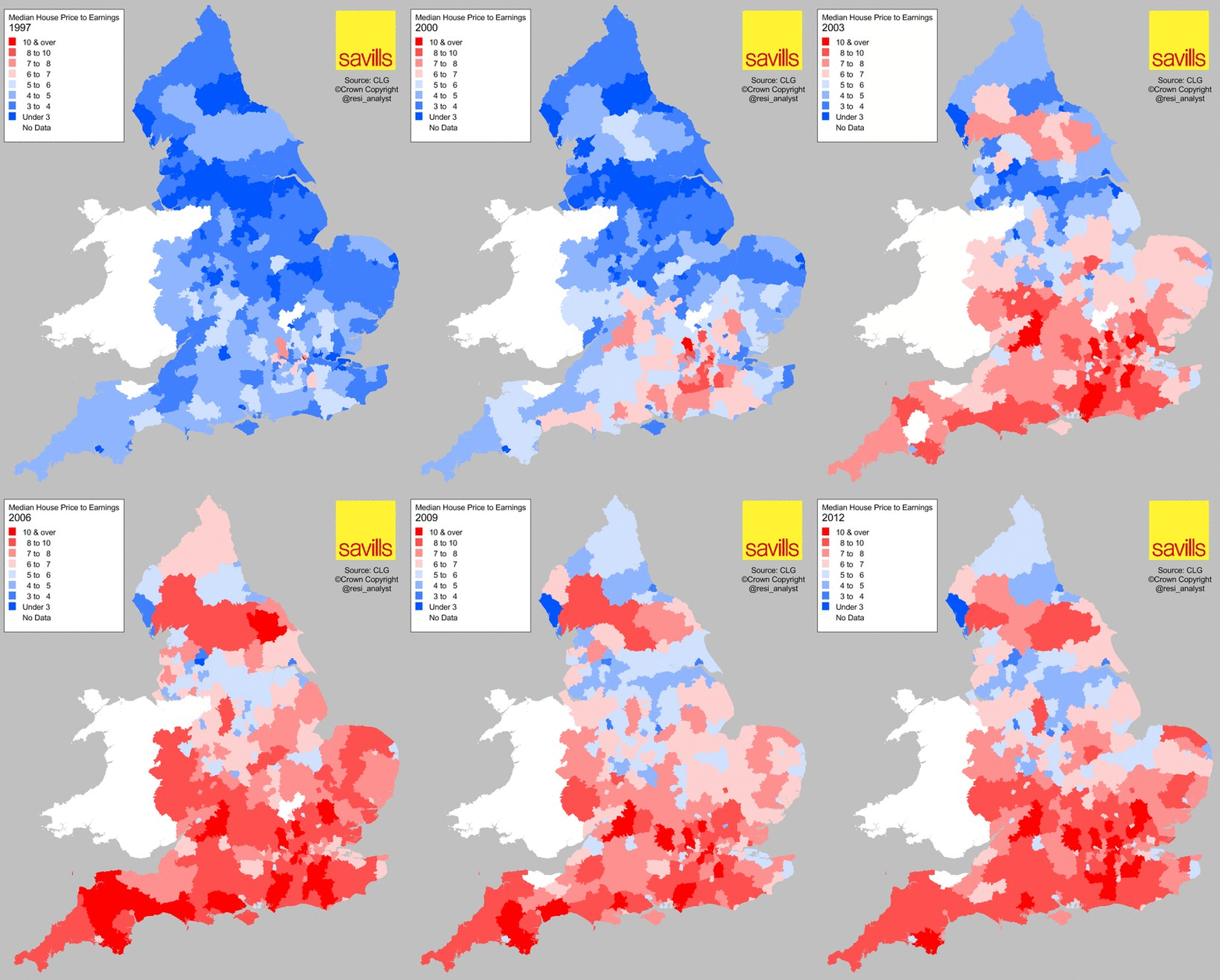
Whilst in London, population density is increasing - it is arguable that the whole effect of an asset-price boom is to make housing unaffordable in the rest of England


In London this had led to some resistance -it will be interesting to see the results elsewhere. Tho' it may be that the unsustainable economic model with provoke another profound crisis within capital flows before then


Laura Oldfield-Ford - flypost Savage Messiah zine
See also http://londonlandscapeobservatory.blogspot.co.uk/2013/09/bo-jo-amends-london-plan-to-limit-caps.html

Wednesday, 4 September 2013

Bo Jo amends London Plan to limit caps to rents - thereby fleecing taxpayers who pay for housing benefits

London Mayor Boris Johnson has made changes to his London Plan, which means that any borough wanting City Hall money to build homes for ‘affordable rent’ must abide by London-wide rent caps of no more than 80% of market rate and maintain an average across the city of 65% of market rate. This has been criticised by the Planning Inspector and prompted an impassioned debate by councils of all political colours and some London Assembly members, because:

  • councils want to be able to set their own rents to reflect their local housing situation
  • even 65% of market rate in some boroughs is ridiculously high


Labour opposed these measures in a Plenary Session of the greater London Authority but failed to get TWO-THIRDS majority required to overturn it.

London Boroughs opposed the move (what about the City of London?) and cite the National Planning Policy Framework 2012

Joint boroughs REMA response 


To which I would only add - who pays these rents anyway? Where households are on low incomes (and 16% of working Londoners earn below a Living Wage) or are unemployed, then taxpayers pick up the tab through Housing Benefit

Housing Benefit cuts already mean that people are going hungry to pay for housing http://www.london.gov.uk/sites/default/files/A%20Zero%20Hunger%20City.doc.pdf . So the mayors policy would appear to attack taxpayers by making them pay more housing benefits whilst attacking the poor - because their benefits are too low to pay for housing -- and all to benefit landlords who are increasing absentee and live abroad (75% of new-build London homes are sold to oversees investors). Thereby, he will suck money out of those least able to pay - to fling it at any foreign speculator.

The upshot is a profound change in the nature of an already "overheated" capital economy, with the poor exiled to a "cursed earth" penumbra of marginalised "poor areas"  -- similar to the ring of poor suburbs around Paris that have proven to be so hard to police. Not a landscape of human values

Friday, 4 January 2013

Year of Air 2013 -- clearly visible pollution kills -- The Department of Health estimates 6.3% to 9.0% of all deaths in London in 2010 were attributable to long-term exposure to man-made PM2.5 alone


Known health and other impacts of air pollution have risen much faster than levels of air pollution have fallen
1.      What is the ‘Year of Air’ in 2013?

The European Commission (Commission) has announced that 2013 is the ‘Year of Air’ with key European air pollution legislation up for review.  The review represents a tremendous opportunity to improve public health by tightening air quality standards.  Commissioner Potočnik made speeches about the ‘Year of Air’ on 22 March 2011 and 24 September 2012.  The Commission has a webpage with details of the EU Review of Air Policy.
Attempts are already being made by the UK authorities to weaken existing air pollution laws during the ‘Year of Air’.  For example, the UK Government has stated ‘Working in partnership with other Member States, we will also use the European Commission review of air quality legislation, expected in 2013, to seek…amendments to the Air Quality Directive which reduce the infraction risk faced by most Member States, especially in relation to nitrogen dioxide provisions’.  Similarly, the Mayor founded a group of 12 European cities and regions that signed a ‘Memorandum of Understanding’ on 10 November 2011 that emphasised The revised [Air Quality] Directive shall include a degree of flexibility that allows the specific characteristics of our Regions to be taken into account’.  Given the Mayor promised Jenny Jones AM on 19 December 2012 that he will ‘oppose any watering down of the current European limit values for reducing air pollution…’ it seems likely that he hopes to achieve ‘flexibility’ through: delays to the legal deadlines; and/or ‘Partnership implementation agreements negotiated between the Commission and Member States in infringement, where further legal action would be suspended subject to proper implementation of agreed transparent and binding programmes to address air pollution’ (or similar) (which is being considered in the Commission’s consultation which closes on 4 March).
Clean Air in London (CAL) believes that key outcomes from the ‘Year of Air’ must include continuity and the further tightening of health and legal protections.  Increasing ‘flexibility’ in air pollution laws would weaken existing health and legal protections and is therefore unacceptable.  CAL is publishing key events planned for the ‘Year of Air’ on its Facebook events page.
Please respond by 4 March 2013 to Commission’s consultation on options for the revision of the EU Thematic Strategy on air pollution and related policies.  There is a briefing page and consultations for four groups: a shorter version for the public; and three longer versions for experts and practitioners: citizens;organisations; and public authorities.
Please write also to your elected representatives in the European and UK Parliaments.
2.      How bad is air pollution in London?
  • London has the highest levels of nitrogen dioxide (NO2) pollution of any capital city in Europe.  Concentrations of dangerous airborne particles (PM10) also breach legal limits in several parts of the city particularly near waste management sites.
  • Government estimates that some 440,439 Londoners were exposed to unlawful levels of NO2 in 2011 at background locations alone i.e. away from busy roads.
  • London’s residents are not the only ones affected by poor air quality.  Every day hundreds of thousands of people commute into the polluted heart of London.  NO2 concentrations are well over twice legal limits and World Health Organisation (WHO) guidelines near many London roadside monitoring sites.  NO2limits are also breached at a larger number of city centre ‘background’ sites away from busy roads.
3.      What are the health impacts of air pollution in London?
  • Air pollution comprises particles and gases.  The particles are categorised by their maximum diameter in microns e.g. PM2.5 and PM10.  In practice, nitrogen dioxide (NO2), a toxic gas, is the only molecule within the gas category with relevant WHO guidelines and legal limits.
  • Poor air quality has a significant impact on the health of London residents.  The Mayor published a study in 2010 estimating 4,267 premature deaths in London in 2008 attributable to long term exposure to fine particles (PM2.5).  These occur mostly as heart attacks and strokes.  The Department of Health estimates 6.3% to 9.0% of all deaths in London in 2010 were attributable to long-term exposure to man-made PM2.5 alone.
  • Children, the elderly and people with existing respiratory illness suffer disproportionately from the effects of air pollution.  Over 1,100 schools in London are within 150 metres of the city’s busiest and most polluted roads (i.e. those that carry over 10,000 vehicles a day).  Traffic pollution from such roads may be responsible for 15-30% of all new cases of asthma in children and chronic obstructive pulmonary disease in adults of 65 years of age and older.
4.      Are there air pollution standards that London should be meeting?
  • Legally binding, health based limit values have been set for several air pollutants by the European Union since 1999.  London is failing to meet these for PM10 and NO2.
  • For PM10 London was required to meet limit values by 2005 but obtained unlawfully a time extension in 2011 to comply that year.  That time extension has now expired but London has continued to exceed PM10 limits known as ‘Bad Air Days’ particularly near waste management sites e.g. Neasden Lane in Brent.
  • NO2 limits were required to be met by 2010.  The Government has admitted they are not expected to be met in London before 2025 and has been caught seeking to weaken NO2 laws.
  • The Commission is expected to commence infraction action against the UK early in 2013.
5.      What are the authorities doing to reduce air pollution in London?
The Mayor of London’s Air Quality Strategy is not ‘fit for purpose’.  The Mayor has also used Pollution Suppressor vehicles to reduce air pollution near air quality monitoring stations most-used to report legal breaches and warn the public of smog episodes.  The Mayor has also been caught lobbying to weaken international air pollution laws.
Diesel engine exhaust, recently classified by the World Health Organisation as carcinogenic to humans, is a particular problem in London which has: some 8,500 diesel buses; over 20,000 diesel taxis; and a low emission zone that is two steps and two years behind the equivalent in Berlin.  A ground breaking study byPolicy Exchange found that diesel vehicles are responsible for 95% of NO2 and 91% of PM2.5 exhaust emissions respectively from road transport in London.
The Government has not published a press release warning of smog since April 2011 when it made headline news.  The Mayor also refuses to issue public warnings of smog even though Murad Qureshi AM discovered that hundreds of additional people in London have been admitted to hospital during smog episodes in the last five years alone.
6.      Supporting guides, links and contacts
Guides
Indoor:              Indoor air quality can be worse than outdoor
Pollutant
Legal standard
World Health Organisation guideline
Short term
Annual mean
Short term
Annual mean
Fine particulate matter (PM2.5)
  1. 25 ug/m3 annual mean to become limit value in 2015
  2. 20 ug/m3 exposure concentration obligation based on a 3-year average by 2015
  3. Exposure reduction target in percentage by 2020
25 ug/m324-hour mean
10 ug/m3
Particulate matter (PM10)
35 days over 50 ug/m3 since 2011
40 ug/m3since 2011
50 ug/m324-hour mean
20 ug/m3
Ozone (O3)
25 days over 120 ug/m3 maximum daily 8-hour mean target value averaged over 3 year since 2010
100 ug/m8-hour mean
Nitrogen dioxide (NO2)
18 hours over 200 ug/m3 since 2010
40 ug/m3 since 2010
200 ug/m3
40 ug/m3
Note: ug/mis micrograms per cubic metre
Examples of legal breaches in 2012
London Air Quality Network:     Marylebone Road
                                          Neasden Lane
                                          Putney High Street
Smog episodes
London Air Quality Network:     Latest hourly bulletin
London Air Quality Network:     Health advice
London Air Quality Network:     Reports on smog episodes
Defra website:                          UK-Air: Air Information Resource (selective monitoring)
Article from The Independent newspaper on the effects of air pollution on athletes, quoting air pollution and health expert Professor Frank Kelly (Kings College, London)


22nd June 2010

29th June 2010
The role of particulates in city-centre air pollution is well known - they are tiny pieces of diesal/petroleum smuts that can stick in your lungs like tar, increasing risk of respiratory diseases. They also trigger the release of stress hormones that release more cholestorol into the blood stream increasing the likelihood of heart attacks. And yet we blithely attribute many of these factors to other "lifestyle choices", shifting the blame onto the individual for their ill-health, whilst "fit" middle-classes live in suburbs with fewer particles and healthier air. Take a look at the two photographs above and below. Both are taken from the far east of London, looking towards the centre. The top one of each set was taken , on a sunny day, after a week of sunny days. The bottom is taken a few days later,  after some decent rainfall. In the second picture, the Canary Wharf office tower blocks are clearly visible, whilst they are obscured in the first. This visible pollution is

23rd June 2010 looking west

29th June 2010 - note Canary Wharf Tower blocks in centre


The photos were taken from the track across Crossness Nature Reserve in east London, on the floodplain on the south side of the Thames. It was drained by monks of Lesnes Abbey in the 13th / 14th century to provide grazing for commercial beef production for the City of London, and/or wool (London was a great exporter of wool in the middle ages). The reserve is a refuge for water voles, who face predation by American mink, amongst other things, elsewhere in south-east England.