7th September 2013 saw the return of the Far-right provocateurs of the (so-called) English Defence League in a third attempt to march on the East London Mosque. Filled with hate, bile, Islamophobia (whipped up by irresponsible newspapers) and a bunch of bare-faced lies (such as
this area of Tower Hamlets is under Sharia Law and you can't buy beer in the area --- believe me, with the highest concentration of alcoholic homeless anywhere in the universe, even lifelong beer drinking atheists like myself would like to see a few less off licences, but that's a different matter, there are plenty of beer outlets in TH, and no sign of Sharia Law unless you voluntarily seek it out and agree to abide by it. In this way it is similar to theJewish Law -
halacha- administered by the Beth Din in the same area just a few years ago!). Yet again Anti-racists assembled on Altab Ali Park (formerly the site of St Mary Matfelon, the original White Chapel.
 |
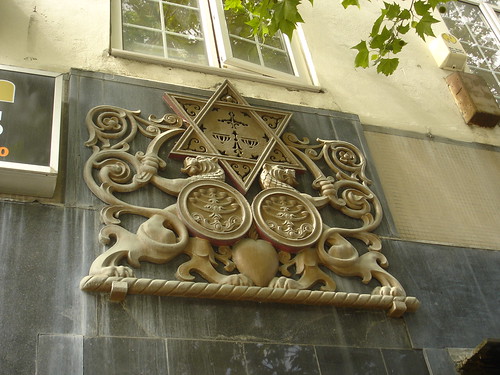
Star of David and scales of justice -
used as the symbol for a former Jewish Newspaper Office |
Whilst this is a pale version, it recalls earlier battles against the far right, when Moseley's Fascists attempted to march through this area (see below). The slogan then, adopted from the Spanish Civil war, and the slogan now is
¡No pasarán! "They Shall Not Pass" , In fact, Max Levitas, the 90+ veteran of the Battle of Cable Street was out mobilising for the action to "Stop the EDL" in the lead up to the march
In 1936 the church still stood, but this area, The top of Leman Street, Gardiners Corner (the west end of Commercial Road) were the areas first secured against the movement of Moseley's Fascists. It was only then that attention moved south to Cable Street.
View Larger Map
The Park itself is named after a young clothing worker murdered by Racists in Adler Street (audio below) in 1978
More on earlier demonstrations and the White Chapel, below
Racist EDL kept out of Tower Hamlets - now celebrate 75th anniversary of the Battle for Cable Street
EDL were prevented from demonstrating in Tower Hamlets on the 3rd of September. They were stopped from going on the rampage like Dudley
Click here for film , where they attacked a Hindu temple and an Indian Restaurant. In Tower Hamlets (after their static demonstration) an EDL coach was prevented from travelling through the area
BBC report of coach.
It had echos of a far larger struggle - that of the 1930s Battle of Cable Street. Which was fought under the Spanish Civil War slogan
¡No pasarán! "They Shall Not Pass" (tho' with fewer numbers on either side)
Like the 1936 Battle, hopefully this will mark a turning point in the growth of the nasty racist "street politics" of the EDL.
The 75th anniversary of the battle is coming up, with a march from Leman Street (Aldgate East tube) a rally in St Georges Gardens and events in Graces Alley and Wilton's Music Hall
click here for more info from
SUNDAY 2 OCTOBER 2011. Which will be a celebration of a united and diverse community.
Click on the blue blobs and lines for information
View Cable Street 75 in a larger map
Altab Ali Park - placemaking, -naming and identity in Whitechapel
Max Levitas, (Communist councillor of the former Stepney Borough, of Jewish heritage) a veteran of the 1936 Battle of Cable Street, addresses the crowd at Altab Ali Day, May 4th 2012, from the
Shaheed Minar, a copy of the Bangladesh memorial to the Bengal language martyrs of the 1950s. For more photos
click here
click here for photos
A
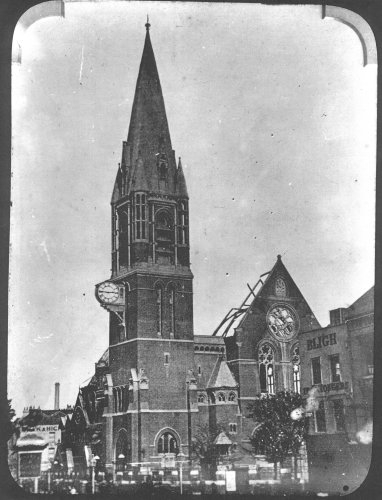
ltab Ali Park has been has been revamped to designs by MUF ArtArchitecture. The Park was named after a local clothing worker who was brutally murdered by racists in the 1970s in Adler Street (named after a famous rabbi). It was formed out of the churchyard for St Mary Matfelon (photo of the 19th-c church left, after a fire). A great many famous - or infamous - people were buried in the churchyard, including the executioner when Charles I was beheaded (Richard Brandon , tho' he may not have wielded the fatal blow).
The church is first referred to in the 13th century, though its origin may be substantially earlier than that. It became a parish church in the 14th century and it leant its common name of the White Chapel, to the parish and district of Whitechapel. There are no reliable images of the medieval church, but it is known to have been extended in 1591. The medieval church, with its short square tower, is first shown on the Faithorne and Newcourt map of 1658. In 1673 the medieval church was in such a poor state that it had to be demolished. The new church is clearly shown on the Ogilby and Morgan map of 1676. Burials ceased in the churchyard in 1854 and in the 1870s the church was rebuilt again. The remains of the medieval church were discovered in the 1870s after the demolition of the 17th-century church. Observations were recorded by George Birch who stated “on removing the brick walls of the seventeenth century church it was found that they had been entirely built on the old walls of the medieval church”. The new church was barely built when it suffered a fire (pictured) and was rebuilt to look the same. This church was bombed during WW2.
The park was rejuvenated by
High Street 2012 and the park reopened formally on March 12th 2012
The design of the new park was informed by an archaeological evaluation
Community dig
and watching brief