Showing posts with label Epping Forest. Show all posts

Wednesday, 21 August 2013

Hundred Horse (sweet) Chestnut

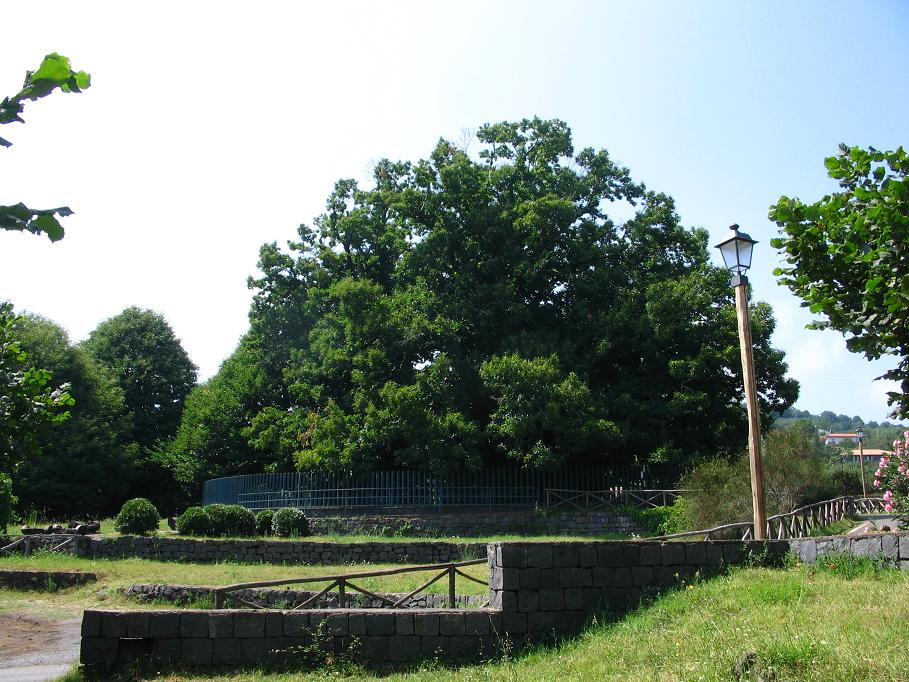
100 Horse Chestnut Today


On this day -286 years ago- the Hundred Horse Chestnut, an ancient tree possibly 2,000 -- 4,000 years old (really!) on the eastern slope of Mount Etna in Sicily, 25 miles north of Catania, was placed under nature protection in in one of the first acts of nature conservancy ever recorded.

“The tree which moves some to tears of joy is in the eyes of others only a green thing that stands in the way. Some see Nature all ridicule and deformity, and some scarce see Nature at all. But to the eyes of the man of imagination, Nature is Imagination itself.” (William Blake)

The “Hundred Horse Chestnut” is probably the oldest tree in Europe and certainly one of the oldest living beings on Earth. The tree itself is composed of three trunks above-ground today, leading to a dispute about the accuracy of the Guinness World Record’s entry that it is indeed the plant with the greatest girth ever – 190 ft, measured in 1780. The ancient sweet chestnut awakened the interest of a host of travellers and natural scientists since the 17th century and their influence probably made the Kingdom of the Two Sicilies react with the unusually progressive act to protect the tree already during mid-18th century.

The “Hundred Horse Chestnut” is named after a local legend, claiming that a Queen Giuvanna, while a-hunting, was caught in a severe thunderstorm and found refuge with her whole retinue under the branches and between the trunks, housing the eponymous hundred horses – and their riders until late in the night. The locals usually added a rather juicy footnote, claiming that the queen found the attention of her various gallants under the sheltering canopy of leaves as well. Who the queen was is uncertain, Joanna the Mad of Spain (1479 – 1555) comes into question, as well as one of the Anjou queens of Naples, Joanna I (1326 – 1382) and Joanna II (1373 – 1435) with the latter having quite a reputation though that might be rooted in her rupture with the papacy when she ruled Naples and Sicily on her own.

The old chestnut was in grave danger in 1923, when a dispute over the belonging of the tree between two local villages culminated in a fire and using it as a place of event for various celebratory banquets didn’t help to preserve it either, thus the site with various other remarkable nature monuments, among them the “Chestnut of the Ships”, at least 1.000 years old as well, was placed under state supervision. Today, the “Hundred Horse Chestnut” is part of the Parco dell’Etna natural reserve, protected but not causing legends beyond the Guinness Book of Records any more.

Depicted above is a gouache of the chestnut by the French painter Jean-Pierre HouĂ«l (1735 – 1813), showing the tree as it looked during the late 1770s, still with the hut built in its shelter that was replaced by various other constructions to house guests later and finally disappeared during the 20th century.

More on: http://en.wikipedia.org/wiki/Hundred_Horse_Chestnut

Other impressive trees...
http://www.mnn.com/earth-matters/wilderness-resources/photos/the-worlds-10-oldest-living-trees/chestnut-tree-of-one

Impressive trees by London Borough http://www.ancient-tree-hunt.org.uk/NR/rdonlyres/4AB3B29D-6DFE-4C1A-A9E1-A1FFC273D52A/0/Londonboroughs17thMay20101.pdf

Veterans of Epping http://www.cityoflondon.gov.uk/things-to-do/green-spaces/epping-forest/wildlife-and-nature/Documents/veteran-trees-leaflet-epping-forest.pdf

Google Street view use toggle-thing to have a look around

View Larger Map

Friday, 25 January 2013

the Medusa Oak: Icon of Medieval Sherwood Forest and Veteran Trees of Epping Forest

Reposted from the excellent....
Archaeology and History of Medieval Sherwood Forest: the Medusa Oak: Icon of Medieval Sherwood Forest:
Picture: Medusa Oak in Birklands Wood, Sherwood Forest national Nature Reserve.


Named 'Medusa' by the Rangers at the Sherwood Forest National Nature Reserve... 

This beautiful ancient oak has survived an attempt to fell her in the not too distant past- and has sprung back to life with serpent-like branches reclaiming her former crown. She sits proud; shrouded in a skirt of moss and lichen surrounded by young oak saplings and slender Silver Birch...

Due north of the Major Oak, Medusa sits at the norteast boundary of Birklands wood (A crown wood in the heart of Medieval Sherwood Forest). A number of Medieval perambulations of the wood mention a boundary 'mere point' or marker known as 'Musmere' ( the mossy boundary mark)... one perambulation goes further and mentions 'A bound called Musmere Oake'. This location is at the northeast of Birklands wood... 

Could this moss and lichen covered oak tree with its reborn crown of serpents be the Musmere Oak of Medieval tradition??

Veteran Trees of Epping Forest -- From http://www.favouritetrees.org/advancedsearch/results.cfm?search_string=tree_records.tree_status_id=7 
...though not quite as old as the Medusa Oak, do however go deep into the 17th century... Theyv are a fantastic resource for study and to inspire and ponder


Page Number:  1 | 2 | 3 | 4 | 5 | 6 | 7 | 8 | 9 | 10 | 11 | 12  ... | Last  Next »

Click on the thumbnails to see a larger view and tree information


Pedunculate Oak
Abbess, Beauchamp and Berners Roding
more of this tree

Native Black Poplar (Water)
Abbess, Beauchamp and Berners Roding
more of this tree

Native Black Poplar (Water)
Abbess, Beauchamp and Berners Roding

Pedunculate Oak
Abbess, Beauchamp and Berners Roding
more of this tree

Pedunculate Oak
Abbess, Beauchamp and Berners Roding
more of this tree

Common Ash
Abbess, Beauchamp and Berners Roding

Pedunculate Oak
Abbess, Beauchamp and Berners Roding

Pedunculate Oak
Abbess, Beauchamp and Berners Roding

Pedunculate Oak
Abbess, Beauchamp and Berners Roding
more of this tree

Pedunculate Oak
Abbess, Beauchamp and Berners Roding

Pedunculate Oak
Abbess, Beauchamp and Berners Roding

Pedunculate Oak
Abbess, Beauchamp and Berners Roding

Wednesday, 19 December 2012

Daily life in Medieval Sherwood Forest- Peasant Rights

Reproduced from http://sherwoodforesthistory.blogspot.co.uk/ - an excellent blog and well worth a browse. Much of this applies also to Epping and Hatfield Forests, which extend into Greater London. Epping Forest was preserved for the public by the Corporation of London as a result of popular resistance in favour of the Commoners Right of Lopping, that is to take lower branches from trees as firewood http://www.hillsamenitysociety.co.uk/detail/efbattle.htm

Daily life in Medieval Sherwood Forest- Peasant Rights


Medieval society and the medieval landscape were for the common person predominantly rural and agricultural in nature.

Very little of the landscape was not utilised, and in some areas such as the ‘Champion’ (from the French champ- for field) landscapes of the Midlands, almost every inch was turned over to arable- especially in the boom years of population expanse during the 13th century.

In Sherwood Forest it was similar, in that almost every resource was used.


Every village had its great open fields, where crops were rotated through the season, and the people farmed strips of land spread throughout them. Each year one field stood fallow to recover for the following years crops.

This fallow field was fertilized by the animals of the village. Pigs and sheep would be concentrated at night into temporary pens to ‘focus’ their fertilization efforts.

Between these times it was necessary to graze animals away from the open fields.

No matter how much an animal fertilizes a field it will always take more nutrients than it returns, if it grazes exclusively from the same field that it fertilizes, as it requires nutrients to grow.

An external source of nutrients and energy was therefore required, and in Sherwood Forest this came from the great heaths and Lyngges ( Old Scandinavian for heather- see There’s Vikings in the Heather entry).

Shepherds and swineherds would tend their flocks and herds on these vast swathes of lowland heath around Sherwood Forest that stretched for mile after mile across the open countryside. Vast areas such as ‘Basforde Lyngges’, the heaths of Rufford Abbey Lordship, ‘Budby Oute Fieldes’ and the ‘Moor of Kirby’, would be dotted with these herds, and the sight of flocks and shepherds would have been common to the traveller passing through the forest.

Each parish had their own areas of woodland, usually at their edges.

In the more populated southern ‘Thorneywood’ area they occupied the high ground between parishes, such as on the ridges between the villages of Lambley, Woodborough and Calverton.

These woods often joined together to form giant woods that could cover miles, but they each had names reflecting to whom they belonged. Carleton Wode, Gedling Wode, Basforde Wode (named after villages) Kettulbarne Haw, Fox Swaht, Prior Stobyn, Samson Wode (after landscape features or owners past and present).

In the ‘High Forest’, (the northern part of Sherwood Forest) these woods were sometimes vast such as the great Maunsfelde (Mansfield) Wode, Sutton Wode, Blidworth Wood and Hay Wode, as well as the great crown woods of the Hay of Birklands, Bilhaugh and Lyndhurst Wood (see Lyndhurst Wood- the chief wood of Sherwood entry).

It is worth reminding that nobody could actually cut down the tress in these woods for timber because it was forbidden by Forest Law (see Forest Law page). However the rights to the woods were heavily guarded by the people, because they had other kinds of rights within them.

As well as the rights to pasture on the great heaths and commons peasants had the right to graze their animals in woodland at certain times of the year. One such time was the ‘Pannage’ season (just after the acorns fell) when peasant could graze their pigs on acorns in the woods of the forest.

Picutre: A peasant beating acorns from the tree for his pigs

These rights to access woods were strictly controlled under Forest Law with ‘Agisters’ acting as tax collectors to control quotas and extract fines (see Forest Law Page)

Peasants also had the right to take some smaller timber from the woods for ‘Haybote’ (hedge repair) and ‘Husbote’ (house repair).

These rights were often jealously guarded!

An Inquisition Post Mortem into the rights of the people of Clipstone Manor, dated20th April 1327 early in the reign of Edward III shows some of the rights of the peasant to the resources of their land.

The Inquisition was presented in front of John De Crombwell Keeper of the Kings Forest beyond Trent, by the oath of John de Annesley; Philip de Caltoft, knight; Thomas Whaton; Richard Russell; Richard Ingam; John de Holm; Richard de Bestewod (Bestwood); Thomas de Lyndeby; Simon de Lameley; John le Warde of Crathethopre; William Basage; and john Moigne of Carleton…

‘The King’s tenants of his manor of Clypston in Shirwod (Sherwood), which is of ancient demesne of the crown of England, and their ancestors, tenants of the same manor, from time immemorial have been accustomed to have all ferns growing in a place which is now called the park of Clypston, for thirteen shillings and six pence, to be rendered yearly to the King’s ancestors by the hands of the justice of the Forest; and to collect the leaves fallen from the trees in the same place for manuring their lands, without rendering anything therefor; and to have pasture for all kinds of beasts in the same, doing in return the custody of the vert and venison in the same place by two of the tenants’.

This shows how the peasants had customary rights to access the ‘park’ for livestock grazing, and to gather ferns and leaves for fertilizer, (in exchange for looking after the deer and timber for the King)

It also shows that they were empowered enough to appeal through the court system to protect those rights.

The reason for the inquest is that Edward II had closed off access to the park, preventing them from their customary rights. The newly crowned Edward III was being petitioned by the men of Clipstone to have their rights returned. They also informed the King that he was losing the money they would normally pay for their rights!!!

Presumably he would be more likely to listen if his wallet was affected.

The men also pointed out that they could not get sufficient pasture outside of the park for their needs- as stated earlier nutrients for flocks and open fields needed to come from somewhere other than the fields themselves.

So as can be seen the landscape of Sherwood Forest provided opportunities for people to make their living from agriculture and from accessing the resources that the Forest provided around them. It was also the case that people would guard these rights vigorously, petitioning through the courts and to the legal system.

The laws of the land prevented many people from having many things, but they also enshrined rights over generations and the law could be called upon to protect those rights if they were threatened.

(More on farming practices in Medieval Sherwood Forest including the ‘Breck System’, and more on the courts and laws of everyday medieval life coming soon).