Thursday, 17 May 2012

Literary Landscape of Britain and Northern Ireland

Literary Landscape http://bigthink.com/strange-maps/565-brit-lit-map 
This marvellous map shows Britain and Northern Ireland as represented by their literary associations. Geoff Sawyer made it for the Literary Gift Company, but you can wander round the Britain of world English imagination for free, here
Briterary Map
Of course, the fun with such maps is in the things you dispute, as well as the things you learn.
What would the literary map of London look like?

Wednesday, 16 May 2012

Rollright stones

I saw this image and loved it - it was taken by Aerial Cam, who I have worked with before. They turn up with a landrover, with a telescopic pole mounted camera and take very good oblique aerial photos (altho' they do a lot more than that, to see the full list click on http://www.aerial-cam.co.uk/). I just think that this single image tells a tale about the physical setting of the monument in rolling hills, and also the prevalence of oilseed rape and the contrast of the green grass of the monument... The Rollright Stones in Oxfordshire, the English Midlands (border with Warwickshire). Archaeologist George Lambrick investigated these in the 1980s, he has subsequently advised the (Irish) Heritage Council on Historic Landscape Characterisation and multi-disciplinary professional development, which I contributed the delivering.


View Larger Map

Open Day, on Sunday, at Pendeford Mill, near Wolverhampton. A managed wood since the 13th century

People will be able to get a rare glimpse of one of Wolverhampton’s nature reserves on Sunday. An open day is being held at Pendeford Mill, a site of valuable environmental and historical significance. The 59 acres of naturally-managed countryside date back to the 13th century and provide a stable and protected habitat for wildlife on the fringe of Wolverhampton, with an ever-changing array of flora and fauna on show. More details at http://bit.ly/LcelRz.  
 For Pendeford Mill and other countryside events in and around Wolverhampton, follow link http://www.wolverhampton.gov.uk/NR/rdonlyres/BFF01928-D09C-4CB2-9295-75493F3A2103/0/CountrysideEventspg233mb.pdf

Pendeford Mill wood bares comparison with Lesnes Abbey Woods, near Thamesmead London http://www.panoramio.com/user/2865482/tags/Lesnes%20Abbey%20Woods.   also managed since the 13th century.  

Tuesday, 15 May 2012

Friends of Medieval Dublin FREE Symposium, 19th May 09.30-17.00hrs


Modern and celebrated Georgian Dublin has accreted around a smaller slimmer Medieval skeleton. But if you want to know why Dublin is like it is today, you must first look to its medieval origins. This FREE seminar would seem an excellent way to open the door to that past landscape - no advanced booking required,
Image of coin with head of Sitriuc Silkenbeard
Admission free. All welcome.
Click here for a printable PDF version of the symposium poster.
Details of last year's: Medieval Dublin Symposium 2011
FRIENDS OF MEDIEVAL DUBLIN14th Medieval Dublin
Symposium
 2012
Robert Emmet Theatre (Room 2037),Arts BuildingTrinity College, Dublin
Saturday 19 May 2012
09.30Registration and opening remarks
Seán Duffy
09.40The archaeology of the priory of All Hallows and Trinity College Dublin: recent discoveries at Front SquareLinzi Simpson
10.30Orator/spokesman/lawspeaker? The airlabraid of Dublin in the tenth century 
Denis Casey
11.10Tea & coffee
11.30James Yonge and the writing of history in late medieval Dublin 
Caoimhe Whelan
12.10How Dublin remembered the Battle of ClontarfLenore Fischer
12.50Lunch
14.00Battle-wounds, murder and death in early medieval Swords: evidence from archaeological excavations at Mount Gamble 
Edmond O’Donovan
14.40The Dublin Vikings and the Clann Cholmáin kings of Southern Uí NéillEoin O’Flynn
15.20Tea & coffee
15.40‘A screpul from every moneyer’: interpreting coin finds from early medieval Dublin 
Andy Woods
16.20
“But what about the earlier city?” – John Rocque’s Exact Survey (1756) as a source for medieval Dublin John Montague
NO ADVANCE REGISTRATION OR BOOKING REQUIRED
For further information, contact Professor Seán Duffy:
sduffy@tcd.ie or telephone (01) 896 1791.

1912 Tailors' strike commemoration, East End Shopfronts, and walks round radical and anti-fascist East End


Public Meeting
Wednesday May 23rd: UNITED AGAINST SWEATSHOP SLAVERY: THE 100th ANNIVERSARY OF THE GREAT 1912 TAILORS’ STRIKE
In April 1912 a strike started among West End tailors. In May, thousands of immigrant Jewish East End tailors came out to support them and to challenge the whole sweatshop system. Dockers in the East End were on strike too for better conditions, and tailors and dockers held joint strike meetings.
Speakers: Ben Gidley, (senior researcher at Compas at Oxford University
working on East End Jewish radical history)
Donnacha DeLong (President of the National Union of Journalists)
7pm-9pm, Library, Bishopsgate Institute, 230 Bishopsgate EC2M 4QH
(Liverpool Street tube). Organised by the Jewish Socialists’ Group

Coming this weekend!
Saturday 19th May, 12-1.30pm, “Protest, Power, Struggle and Strife. No Pasaran!” Special walk by David Rosenberg for the Rich Mix “Snapshots” festival. £8.50. Bookings: http://www.richmix.org.uk/whats-on/event/no-pasarn-guided-walk/ Box office: 020 7613 7498

Sunday May 20th at the new Goldsmiths Row Sunday Book Market, David Rosenberg will be signing copies of “Battle for the East End” between 12.30-1.30pm at the Newham Bookshop stall which will be specialising in London and radical books. The book market, which started last weekend will run every Sunday from 9am-4pm

Exhibition
“After You've Gone: East End Shopfronts, 1988”
Alan Dein's photographs of East End shopfronts were taken in 1988 when many Tower Hamlets streets were on the verge of dereliction. Alan, an oral historian and broadcaster, captured the diminishing, decaying local shops on film, most of them relics of the area's once flourishing Jewish community. The exhibition launches on Thursday 17 May at 6pm, with a talk from Alan on Saturday 9 June at 2.30pm and it runs until Thursday 12th July at tower hamlets local History Library, 277 Bancroft Road, London E1 4DQ.

Finally – David Rosenberg's regular walks:

Sunday 10th June 11am. Guided walk  “Anti-Fascist Footprints: a walk through the 1930s East End from Gardiners Corner to Cable Street. £7/£4. Book online at: www.eastendwalks.com

Sunday 24th June 2.30pm. Guided walk  “The Spark of Rebellion in Bow and Mile End”. £7/£4. Book online at: www.eastendwalks.com

Monday  2nd July, 6pm. Guided walk “The Radical Jewish East End”. £7/£4. Book online at: www.eastendwalks.com

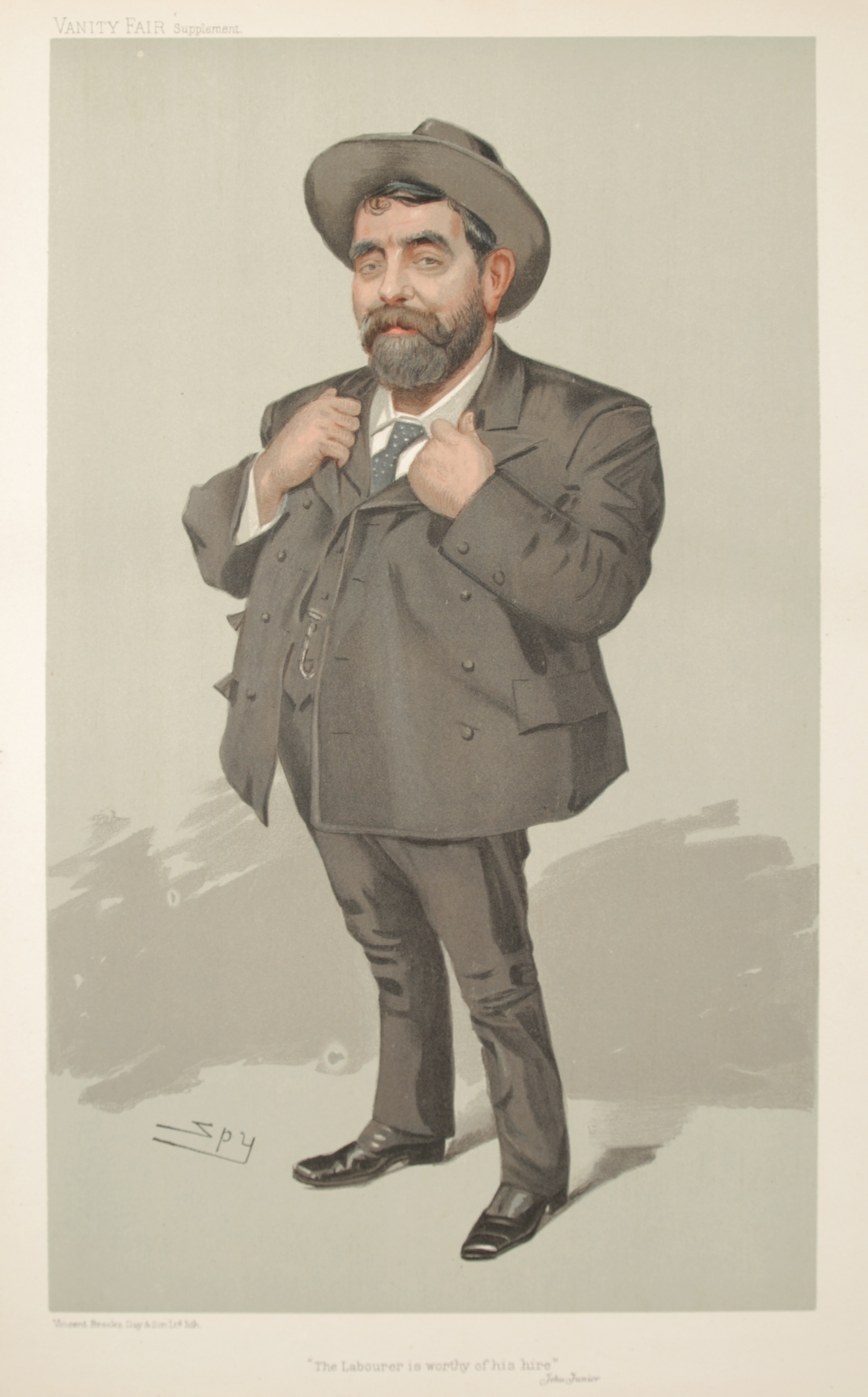
Will Crooks, a celebration of (his) life (including Island Gardens park and the Blackwall Tunnel river crossing)

Will Crooks grave in Tower Hamlets Cemetery Park http://www.panoramio.com/photo/70801819 


Will Crooks: A celebration.  Tuesday 29th May, 6:30pm - 8:30pm at St. Matthias Community Centre, Poplar High Street
This event will celebrate the 160th anniversary of the birth of Will Crooks - Trade Unionist, the fourth Labour Member of Parliament and first Labour Mayor of Poplar.
Speakers will includ Nick Raynsford, Member of Parliament for Greenwich and Woolwich and David Edgar, councillor for Limehouse.
RSVP to: ramona.losip@canarywharf.com or 020 7418 2462.

"The Labourer worth his Hire" Vanity Fair 6th April 1905
Wkkipedia say
William (Will) Crooks (6 April 1852 – 5 June 1921) was a noted trade unionist and politicianfrom Poplar, London, and a member of the Fabian Society. He is particularly remembered for his campaigning work against poverty and inequality.

[edit]Biography

Born in Shirbutt Street, Poplar, Crooks was the third son of a ship's stoker, George Crooks, who lost his arm in an accident when Crooks was three years old. His mother, Caroline Elizabeth (née Coates), then supported the family by working as a seamstress, but money was scarce and five of the children were temporarily forced to enter Poplar workhouse in 1861. This experience had a profound influence on Crooks' views on poverty.
Educated at a local Poor law school, Crooks worked initially as a grocer's errand boy, then a blacksmith's labourer and then as an apprentice cooper. A keen reader, Crooks learned about reformers such as Richard Cobden and John Bright, and was asked by his fellow workers to speak out about their working conditions. Consequently, he was sacked for being a political agitator. He remained a member of the Coopers Union from 1867 until his death in 1921.
After a short spell working in Liverpool, Crooks returned to London and found work in the docks. He also began to give political lectures, and his speaking abilities proved helpful in raising funds for 10,000 striking dockers in the 1889 London Dock Strike.
Earlier that year, Crooks, a candidate for the Progressive Party, successfully stood for election to the London County Council, and joined Sidney Webb and other labour movement leaders in the LCC. He also became the first working-class member, and later chairman, of the Poplar Board of Guardians. With support from friend and fellow member George Lansbury, Crooks set about reforming the local workhouse, creating a model for other Poor Law authorities.
A prominent local politician, he helped bring about many local improvements. On 3 August 1895, Crooks formally opened Island Gardens, a park at the south end of the Isle of Dogs, opposite Greenwich Hospital. He also campaigned for the first Blackwall Tunnel, and as Chairman of the LCC Bridges Committee in 1898, he helped provide the Greenwich and Woolwich foot tunnels (completed in 1902 and 1912 respectively).
In 1901 Crooks became the first Labour mayor of Poplar, and two years later was elected to Parliament as MP for Woolwich. This success was the result of a pact between the Labour Representation Committee and the Liberal Party, which wrested the seat away from theConservative Party). At the time, he was only the fourth Labour MP (preceded by James Keir Hardie, Richard Bell and David Shackleton; Arthur Henderson followed later in 1903).
As an MP, he retained his working-class roots and contacts, campaigned hard for workers'pensions, supported reforms to limit the powers of the House of Lords, and supported Balfour’s Unemployment Bill in 1905. Re-elected in 1906, he supported the reforming Liberal governments of Campbell-Bannerman (1906–1908) and Asquith (1908–1910).
In 1901 Crooks became the first Labour mayor of Poplar, and two years later was elected toParliament as MP for Woolwich. This success was the result of a pact between the Labour Representation Committee and the Liberal Party, which wrested the seat away from theConservative Party). At the time, he was only the fourth Labour MP (preceded by James Keir Hardie, Richard Bell and David Shackleton; Arthur Henderson followed later in 1903).
Crooks lost his seat in Parliament at the January 1910 general election, but was re-elected at the December 1910 general election, and remained an MP until ill-health forced his retirement in February 1921. He died in the London Hospital, Whitechapel four months later, and was buried in Tower Hamlets Cemetery.
In 1930, one of the Woolwich Ferry paddle-steamers was named in his memory (taken out of service in 1963). A council housing estate in his native Poplar still bears his name, as does a road in Eltham, just south of Woolwich.

[edit]External links


Friday, 11 May 2012

Xcavate! Dorset's Community Archaeologist: Jubilee Walks


Xcavate! Dorset's Community Archaeologist: Jubilee Walks: This coming Jubilee stride out into the Dorset countryside and see sites that have been gracing our landscape for far longer than 60 years

A great way to mooch around landscape with a knowledgeable friendly host - a London refugee gone native in the countree

Landmark of London, Wellington Arch at Hyde Park Corner

I've long insisted on the importance of landmarks within landscape studies, and specifically Historic Landscape Characterisation. They define and declare territory, they act as waymarks, in fact they have a host of uses, including projecting image and ideology. One such is the Wellington Arch at Hyde Park Corner. Nowadays it is more comfortably known just as "Hyde Park Corner". The arch has lost its specific association with Wellington as a result of a change of statue on the top. Nowadays it is a generic personification of Victory

However, formerly it had a statue of Wellington  (click here for English Heritage record and photograph), which shows a "general" view of the Duke of Wellington (their pun not mine) on the Wellington Arch on Hyde Park Corner. The statue was designed by Matthew Wyatt and erected on top of Decimus Burton's Triumphal Arch. It is nearly 30 feet high and in the 1880s was moved to Aldershot.

Thursday, 10 May 2012

Olympic missiles and the worst civilian disaster of WW2 in the East End of London

Graves of some of the 173 victims of the Bethnal Green Tube disaster. On 3 March 1943, as the British press had reported a heavy RAF raid on Berlin on the night of 1 March. The air-raid Civil Defence siren sounded at 8:17 pm, causing an orderly flow of people down the short flight of steps into the underground booking office area. At 8:27, an anti-aircraft battery a few hundred yards away in Victoria Park launched a salvo of a new type of anti-aircraft rocket. The weapon was secret and the unexpected, unfamiliar sound of the explosion caused the crowd to surge forward towards the shelter, a woman tripped on the stairs, causing many others to fall. Within a few seconds 300 people were crushed into the tiny stairwell. 172 people died at the scene, with one more dying in hospital later; 62 of the dead were children.

Relatives visit the graves regularly, many following an annual memorial service, with a larger event every ten years

Please donate to the Stairway to Heaven memorial

An Olympic surface to air Missile battery has been proposed for the water tower on top of the Bow Quarter, the former Bryant and May match factory,  scene of the bitter industrial struggle by matchgirls led by Annie Besant  
Annie Besant Memorial - Bryant and May match factory
Former Bryan and May match factory with water tower, site of missile battery


The locations of the WW2 ansd Olympics missile batteries are remarkably close (see map below)

View Larger Map